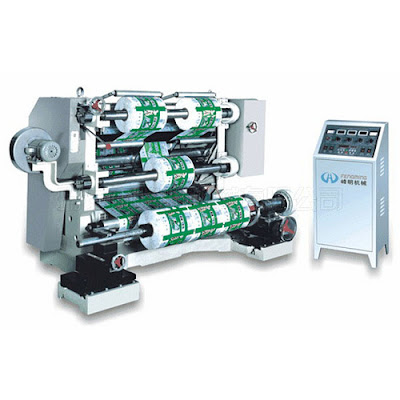
Slitting Machine--Automatic Slitting Machine

China's State Council, or cabinet, said on Thursday that the central government would allocate 10 billion yuan ($1.46 billion) in subsidies for agricultural machinery purchases next year to help farmers and returning migrants.
At an executive meeting presided over by Premier Wen Jiabao, the council said that "to provide such subsidy could raise the country's agricultural mechanization level and boost the development of the farm machinery industry and economic development".
The amount of the subsidy was 6 billion yuan more than in 2008, and it will be available to farmers and farm workers across the country.
This plan was another important way to boost domestic demand apart from providing subsidized household appliances for farmers, said the meeting.
The government promised to grant a 13-percent subsidy for farmers' purchase of household appliances including color TV sets, refrigerators, mobile phones, washing machines and freezers starting in December 2007.
"China should take more active measures to create jobs and lay special importance on the employment of migrant workers, as some domestic enterprises ran into production and operation difficulties amid the adverse impact of the global financial turmoil," said the meeting.
Local governments should streamline the procedures involving land use, taxation, business registration and other functions as well as providing better financial services to help migrant workers who return home to start businesses, said the meeting.
Local authorities should also ensure migrant workers are promptly paid by employers, provide them with good social security services and protect their land contract rights as they return to their rural homes, according to the meeting.
China has about 210 million migrant workers who have left their rural hometowns to work in cities and towns.
Japanese machinery orders fell in October as the deepening global recession choked off demand for the country’s cars and electronics.
Orders an indicator of capital spending in the next three to six months, slid 4.4 percent from September, when they rose 5.5 percent, the Cabinet Office said today in Tokyo. Bookings received from abroad, which are excluded from the headline figures, tumbled 37 percent, the biggest drop in five years.
Falling profit for Japan’s exporters has driven the Topix stock index down 44 percent this year and forced the country’s biggest companies to slash production, fire workers and cut spending. Sony Corp. said yesterday it will eliminate 16,000 jobs and reduce capital investment in its electronics business by 30 percent over the next two years.
“It’s inevitable that business investment will keep falling because the drop in overseas demand is so huge,” said Yasuhide Yajima, a senior economist at NLI Research Institute in Tokyo. “The reduction in investment and jobs will make Japan’s recession very deep and prolonged.”
The Topix index of machinery makers lost 0.3 percent as of 10:41 a.m. in Tokyo, compared with a 0.3 percent increase in the benchmark stock gauge. Komatsu Ltd. and Mitsubishi Heavy Industries Ltd. led the declines.
The yen traded at 92.50 per dollar from 92.24 before the report. Japan’s currency has climbed 15 percent since September, compounding exporters’ woes by eroding the value of their earnings made abroad.
Shrinking Economy
The world’s second-largest economy shrank at an annual 1.8 percent pace last quarter, a report showed yesterday, as businesses cut spending and inventories. The recession has since deepened: in October, exports fell at the fastest pace in seven years, production slumped, job prospects fell to a four-year low and household spending tumbled for an eighth month.
Morgan Stanley today cut its outlook for Japan, saying gross domestic product will shrink 2 percent next year, matching the country’s “postwar nadir” of 1998. The impact of the global financial crisis on the economy “is worse than we envisaged,” said Takehiro Sato, chief Japan economist at Morgan in Tokyo.
The Bank of Japan’s quarterly Tankan survey next week will show sentiment among large manufacturers fell the most in 34 years, according to economists surveyed by Bloomberg.
“Japan’s economy is in far worse shape than feared,” said Glenn Maguire, chief Asia-Pacific economist at Societe Generale SA in Hong Kong. “The contraction in capital spending is therefore likely to be particularly severe in the fourth quarter.”
Tool Orders Plunge
The monthly drop in orders was in line with economists’ estimates for a 3.9 percent decrease. Year on year, orders tumbled 15.5 percent, the steepest decline since June 2007.
November bookings for machine tools slid the most in at least 21 years, plunging 62 percent from a year earlier, the Machine Tool Builders Association said yesterday.
Mitsubishi Chemical Holdings Corp. will cut equipment investment 27 percent to 430 billion yen ($4.6 billion) by March 2011, the Tokyo-based company said yesterday.
The Bank of Japan forecasts business investment will stay sluggish for the next several quarters. The central bank cut its benchmark interest rate to 0.3 percent in October, the first reduction in seven years, and some economists predict a return to zero rates in coming months.
“Monetary policy will take on more of the character of fiscal policy, under pressure from the markets,” said Morgan Stanley’s Sato. “We envisage two further rate cuts to get us back to the zero interest-rate policy” by March, he said.
Taking into account the global economic slowdown led to reduced overseas demand, machinery manufacturers have cut their investment plans, leading to Japan's machinery orders fell 10.4 percent last season, the biggest drop over the past 10 years.
Machinery orders data in Japan has been a leading indicator of investment in equipment, the Japanese Cabinet Office said in Tokyo yesterday, machinery orders drop is the signal reducing investment in the next three to six months.
Reduce of Japanese exporters' profits this year have resulted in the Nikkei 225 index fell 44 percent, and forced some of Japan's largest companies to cut down costs. Toyota Motor Corporation of Japan anticipated last week the fiscal year revenue will be reduced by 70%, and plans to reduce the staff and investment.
"Demand reduction has been very clear, which suppress the will of the investment." BNP Paribas senior economist in Tokyo Maruyama is forecast, "we will see more companies to reduce the cost in greater scope."
U.S. shipments of packaging machinery climbed for the sixth-consecutive year, up 3.9% to an estimated $6.02 billion, according to PMMI’s 2008 Shipments & Outlook study.
Exports increased 17.8% to $1.16 billion, with the declining value of the U.S. dollar offering an advantage for selling domestic products abroad.
Domestic shipments, at $5.05 billion, grew only 1.2%, as many U.S. customers were wary of committing to large purchases.
Packaging machinery manufacturers’ order backlog at the end of 2007 was down 9.1% to $1.63 billion, again largely due to wariness about the state of the economy.
This most recent report, while still positive, is a far cry from the 9.3%, 8.1% and 6% recorded in 2004, 2005 and 2006, respectively. Demand from U.S. customers climbed sharply in those years, but was up just modestly in 2007.
Capping (15.4%) and cartoning (14.7%) machinery posted the strongest gains, pushed by strong exports. Shipments for all but two machinery categories (form/fill/seal machinery and skin and blister sealing machinery) posted positive results.
Other findings included:
Manufacturers continued to introduce new equipment models with value-added benefits.
Sustainability issues influenced packagers, creating demand for machinery able to handle lighter gauge materials, reduce waste and energy coasts.
Packagers remained committed to increasing security by improving tracking, contaminant detection, integrity and counterfeit prevention.
U.S. customers began to delay and cancel projects, particularly during the second half of the year as the economy began to wane.
Foreign competitors continued to increase their presence in the market.
Competition among U.S. packaging machinery manufacturers became more aggressive, leading to reduced unit prices.